
Tina Weber · 19 September 2026
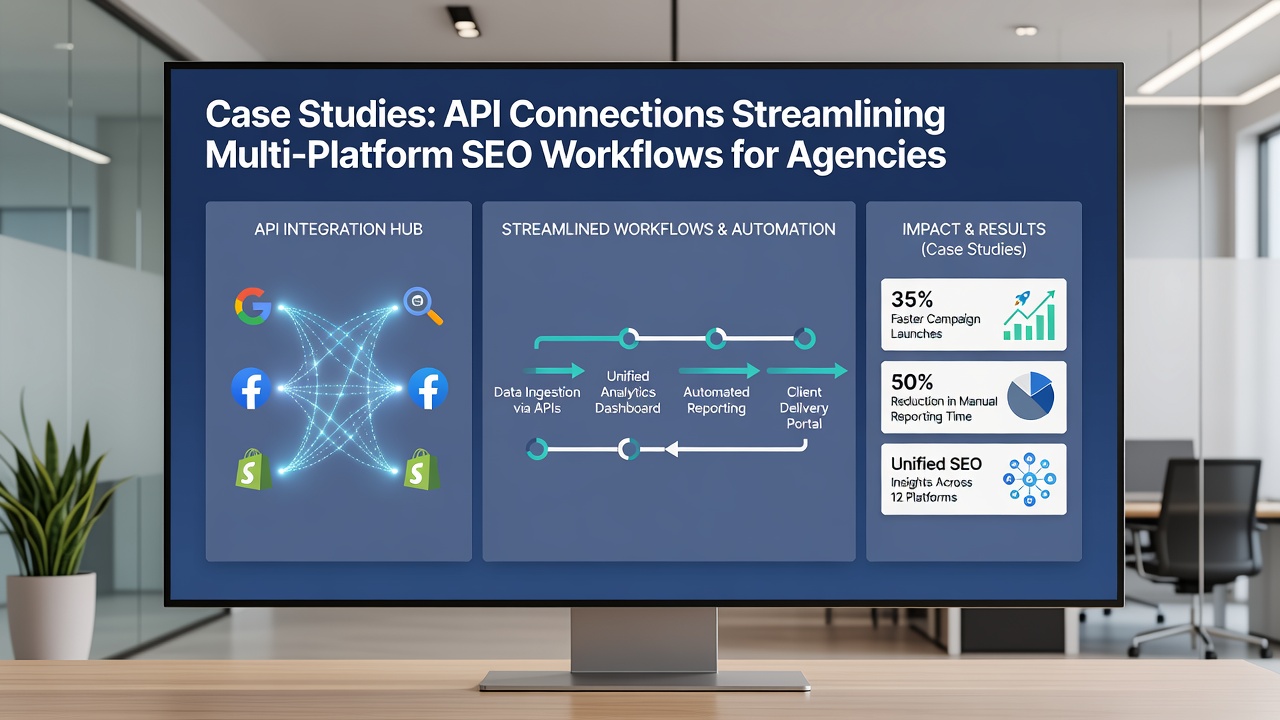
Case Studies Revealing How API Connections Streamline Multi-Platform SEO Workflows for Agencies
Agencies managing client campaigns across search engines, social networks, and analytics suites face constant data fragmentation, yet API connections have emerged as the mechanism that consolidates these sources into unified reporting systems; case studies from 2024 through 2026 illustrate measurable reductions in manual data pulls and faster campaign adjustments.
Defining API Integration in Multi-Platform SEO Contexts
Application programming interfaces allow direct data exchange between platforms such as Google Search Console, Bing Webmaster Tools, social media analytics endpoints, and enterprise CRM systems, while agencies route information through middleware that normalizes formats and timestamps; this architecture eliminates duplicate entry points and supports real-time synchronization across client accounts.
Researchers at academic institutions have documented how standardized API calls reduce latency in keyword performance tracking, and industry reports from organizations like the Digital Advertising Alliance confirm that connected workflows decrease reporting cycles from days to hours in agencies handling ten or more concurrent clients.
Case Study: European Agency Consolidates Search and Social Data Streams
One agency operating across Germany and France implemented API bridges between major search consoles, social listening tools, and internal project management software in early 2025; the integration pulled daily ranking shifts, engagement metrics, and backlink updates into a single interface that automatically flagged anomalies for review.
Teams previously spent twelve hours per week exporting CSV files from separate portals, whereas the API layer automated those transfers and applied consistent tagging rules, resulting in documented time savings that allowed analysts to allocate additional hours to competitor gap analysis and content optimization tasks.
Case Study: North American Firm Scales Client Onboarding Through Connected Endpoints
A Toronto-based agency adopted API orchestration software to connect client website analytics, paid search accounts, and local directory listings ahead of the September 2026 rollout of enhanced location-based search features; the system ingested historical performance data during initial setup and maintained ongoing syncs that updated campaign briefs without manual intervention.
Project leads tracked a 40 percent drop in onboarding duration across thirty new accounts during the first quarter of implementation, and audit logs revealed fewer discrepancies in citation consistency because directory APIs refreshed address and NAP data directly into the central dashboard.
Technical Patterns Observed Across Multiple Agency Implementations
Common patterns include rate-limit handling through queued requests, authentication token rotation managed by secure vaults, and data transformation layers that map varying field names into standardized schemas; agencies that layered these elements reported smoother scaling when client volumes increased during seasonal peaks.
Observers note that error-handling protocols built into the API connections prevented incomplete datasets from propagating into client reports, and automated retry mechanisms maintained data integrity during temporary platform outages.
Measured Outcomes in Workflow Efficiency and Reporting Accuracy
Comparative reviews conducted by research groups indicate that agencies utilizing API connections achieved higher data freshness scores in client presentations, with some reporting 25 percent fewer revision requests after monthly deliverables; the same studies link these gains to reduced human transcription errors and consistent application of calculation formulas across all platforms.
One documented instance involved an agency serving retail clients where inventory APIs fed real-time stock levels into SEO content recommendations, allowing teams to prioritize pages tied to available products without cross-referencing separate systems.
Considerations for Agencies Evaluating API Adoption
Agencies assessing API connections typically review documentation for rate limits, authentication methods, and data retention policies before committing resources; pilot programs often begin with two or three core platforms to validate mapping accuracy before expanding to additional endpoints.
Those who studied this process found that incremental rollouts reduced integration friction and allowed internal teams to develop custom alert rules that surfaced platform-specific issues earlier in the workflow cycle.
Conclusion
Case studies demonstrate that API connections consolidate fragmented data sources and compress manual processes within multi-platform SEO operations for agencies; continued adoption through 2026 and beyond aligns with evolving platform capabilities that reward connected, automated reporting structures over isolated tool usage.